





LES ERES
A l’entrada del carrer de Sant Marc, en direcció la plaça d’aquest mateix nom, ens trobem amb un solar que hostatja un xicotet jardinet, ací era on estava la casa del tio Evaristo Alemany Gascó, un dels dos fusters del poble i alcalde de la postguerra. Tot seguit, tenim l’entrada del poble des del barranc, on també hi havia dues eres de batre escalonades, una més pròxima al poble i l’altra més pròxima al llit del barranc. Els xiquets i xiquetes jugaven al futbol en la primera era, amb el problema que quan la pilota queia al barranc tardaven mitja hora a recollir-la.
A continuació, la primera casa de la dreta on vivia el darrer manyà del poble, Vicent Seguí Camps, el de la Marinés.
A la part esquerra de l’inici del carrer, observem una mena de font i bassa, que correspon al Museu l’Almàssera dels Moltó.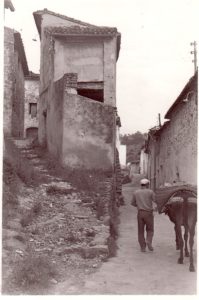


LAS ERAS
En la entrada de la calle de Sant Marc, en dirección a la plaza con este mismo nombre, nos encontraremos con un solar que hospeda un pequeño jardín, aquí era donde estaba la casa del tío Evaristo Alemany Gascó, uno de los dos carpinteros del pueblo y alcalde de la posguerra. A continuación, tenemos la entrada del pueblo desde el barranco, donde también había dos eras de trillar escalonadas, una más próxima al pueblo y la otra más próxima al lecho del barranco. Los niños jugaban al fútbol en la primera era, con el problema de que cuando la pelota caía al barranco tardaban media hora a recogerla.
A continuación, la primera casa de la derecha donde vivía el último cerrajero del pueblo, Vicent Seguí Camps, el de la Marinés.
En la parte izquierda del inicio de la calle, observamos un tipo de fuente y balsa, que corresponde al Museu Almazara de los Moltó.

THE THRESHING AREAS
At the beginning of Carrer de Sant Marc, going in the direction of the square of the same name, there is a plot of land that houses a small garden. This was where Uncle Evaristo Alemany Gascó’s house was located, who was one of the two carpenters in the village and the postwar mayor. A little further on, there is the entrance to the village from the ravine, where there were also two tiered threshing floors, one closer to the village and the other closer to the bottom of the ravine. Boys and girls played football in the first area, with the typical problem of needing maybe half an hour to fetch the ball if it fell into the ravine.
Further on, the first house on the right is where the last locksmith of the village lived, whose name was Vicent Seguí Camps.
On the left side of the street, there is a kind of fountain and pond, which belongs to the Moltó Mill Museum.